"Dedicated to the soul of my mother, Rugaia, and to all Sudanese mothers; reflecting the taste and color of our homeland's soil.إهداء إلى روح أُمي رُقيّة، ولكلّ الأمهات السودانيات طعم ولون تراب الوطن.
I was born in Marawi, northern Sudan, in Al Zouma village, at my grandmother Sitt Nour's house on a bend of the Nile. Here, the Nubian culture of farmers along the riverbank intertwines with the desert extending into Egypt. I remember the houses on hills and highlands, their white facades and the gentle sway of palm trees, all of which have woven themselves into the fabric of my memories. These images have resonated within me throughout my visits to that Nubian spot along the Nile, over three decades echoing in this exhibition.
الطار آلة إيقاعية تُصنع من جلد الغنم الطري، وتُشَد على خشب له مقاسات متنوعة. توجد في الشريط النيلي النوبي الممتد من السودان إلى مصر، تُضرب عليه الإيقاعات النوبيَّة، وامتدّ ليصبح آلة المديح النبوي الأساسيّة كما في تجربة أولاد حاج الماحي العريقة. استخدمها الموسيقار النوبي العالمي حمزة علاء الدين وقدَّم بها الإيقاعات النوبية
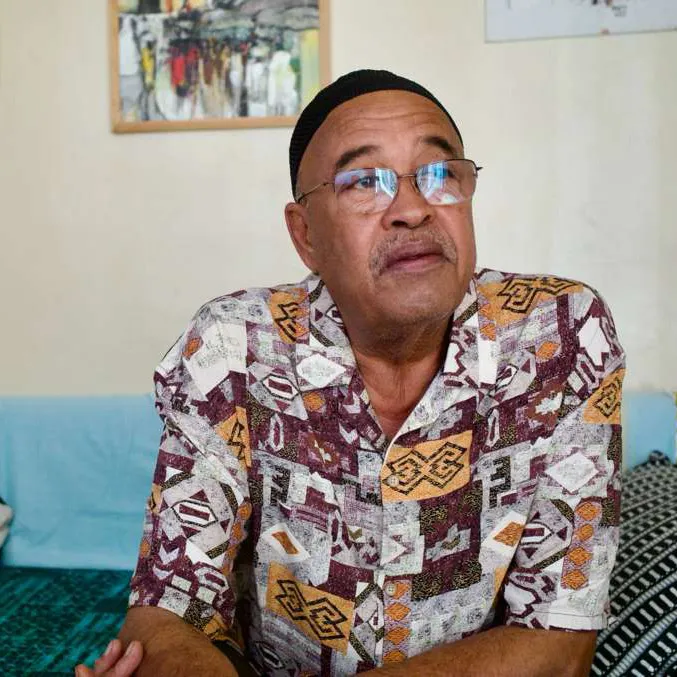
Issam Hafiez is a Sudanese painter, photographer, and graphic designer whose practice centers on painting as a primary means of exploring memory, identity, and lived experience. His work is distinguished by expressive mark-making and a material-driven approach that pushes the boundaries of paint, creating surfaces charged with urgency, emotion, and historical resonance. Through layered textures and gestural forms, Hafiez transforms everyday life into powerful visual narratives that reflect Sudan’s social and cultural realities.
The works in this exhibition highlight diverse aspects of Sudanese collective life, particularly in relation to urban spaces and social environments. The colours - reminiscent of the tar - depict various facial features and body gestures as interconnected elements that transcend ethnicity and geography. Social and cultural differences are expressed through connectivity, emphasizing the uniqueness of each human face and element within the paintings' spatial composition. Art, as a tool for social cohesion and activism, is what makes Issam's exhibition important, as it promotes a perspective that links cultural diversity with social coexistence.Hafiez graduated in 1982 with a B.A. in Graphic Design from the Faculty of Fine and Applied Arts, Khartoum Polytechnic. While trained within a formal, technique-based tradition, his practice has evolved into a highly individual language that emphasizes experimentation, abstraction, and the physicality of paint. Alongside his painting, his background in photography and design continues to inform his visual sensibility and compositional approach.
Notable solo exhibitions include Seasons of Memory at Khartoum Art Center (1996), exhibitions at the French Cultural Center in Khartoum (1996, 2011), Cry Azoum at the German Cultural Center in Khartoum (2001, 2004), Behind the Doors (2011), and Black & White: January 10th; Once Again in Nairobi (2025). His work has also been featured in group exhibitions and international events, including the Cairo Biennale, Moscow Youth Festival, Sudan Art Aid in London, and exhibitions across Africa, the Middle East, and Europe. In 2026 he participated in the Africa Basel Art Fair in Basel, Switzerland, with Circle Art Gallery.
His works are held in collections in Khartoum, Kampala, Cairo, and Syria. Now based in Nairobi, Hafiez continues to develop painting-led projects that engage with memory, displacement, and resilience.
-
 Issam HafiezNubian Tar (IV), 2026Ink on canvas50 cm diameter
 -
Issam HafiezNubian Tar (VI), 2026Ink on canvas40 cm diameter
-
Issam HafiezNubian Tar (II), 2026Ink on canvas40 cm diameter
-
Issam HafiezNubian Tar (III), 2026Ink on canvas50 cm in diameter
-
Issam HafiezNubian Tar (V), 2026Ink on canvas50 cm diameter
-
Issam HafiezNubian Tar (I), 2026Ink on canvas40 cm diameter
-
Issam HafiezMy Horizon, 2026Acrylic on canvas98 x 79 cm
38 5/8 x 31 1/8 inCopyright The Artist -
Issam HafiezMissing Land I, 2026Acrylic on canvas88.3 x 60 cm
34 3/4 x 23 5/8 in -
Issam HafiezAbsence of Features II, 2026Acrylic on canvas90 x 90 cm
35 3/8 x 35 3/8 in -
Issam HafiezThe Great Loss, 2026Ink and acrylic on canvas140 x 174.5 cm
55 1/8 x 68 3/4 inCopyright The Artist -
Issam HafiezThe Great Escape, 2025Black ink on canvas board60 x 44.4 cm
23 5/8 x 17 1/2 inCopyright The Artist -
Issam HafiezWe Are Together, 2013Black ink on canvas40 x 40 cm
15 3/4 x 15 3/4 in -
Issam HafiezHouse of Ghosts, 2025Acrylic on canvas90 x 90 cm
35 3/8 x 35 3/8 in -
Issam HafiezSad Mothers, 2023Acrylic on canvas30 x 30 cm
11 3/4 x 11 3/4 in -
Issam HafiezWar Wounds, 2024Acrylic on canvas73.5 x 74 cm
29 x 29 1/8 in -
Issam HafiezMissing Faces, 2024Acrylic on canvas89 x 89 cm
35 x 35 in -
Issam HafiezThe Lady (Noora), 2025Acrylic on canvas90 x 60 cm
35 3/8 x 23 5/8 in -
Issam HafiezAbsence of Features (I), 2026Acrylic on canvas140.5 x 173 cm
55 1/4 x 68 1/8 in -
Issam HafiezCrying Faces I, 2026Acrylic on canvas140 x 175 cm
55 1/8 x 68 7/8 in -
Issam HafiezNubian Echoes III, 2026Acrylic on canvas140 x 175 cm
55 1/8 x 68 7/8 in -
Issam HafiezCrying Faces II, 2026Acrylic on canvas140 x 174.5 cm
55 1/8 x 68 3/4 in -
Issam HafiezPeople I, began 2014 finished 2024Inks and acrylic on canvas80 x 54.5 cm
31 1/2 x 21 1/2 inCopyright The Artist -
Issam HafiezNubian Motifs, 2000Acrylic on canvas54 x 56 cm
21 1/4 x 22 in -
Issam HafiezSadness Zone, 2019Acrylic on canvas59.4 x 59 cm
23 3/8 x 23 1/4 inCopyright The Artist -
Issam HafiezVillage Evenings, 2008Oil on canvas58.7 x 50.3 cm
23 1/8 x 19 3/4 in -
Issam HafiezGoing to the Market (Zouma), 2016Acrylic on canvas board30 x 24 cm
11 3/4 x 9 1/2 in -
Issam HafiezNubian Echoes I, 2005Acrylic on canvas40 x 49.7 cm
15 3/4 x 19 5/8 in -
Issam HafiezMy Lost Memory, 2004Acrylic on canvas55.2 x 55.2 cm
21 3/4 x 21 3/4 in -
Issam HafiezEmpty Village, 2020Acrylic on canvas60 x 60 cm
23 5/8 x 23 5/8 in -
Issam HafiezMy Village (Zouma), 2020Acrylic on canvas88.5 x 59.5 cm
34 7/8 x 23 3/8 in -
Issam HafiezDistorted Faces II, 2024Ink on paper24 x 18 cm
9 1/2 x 7 1/8 in -
Issam HafiezThe Face, 2026Ink on paper28 x 19.4 cm
11 x 7 5/8 in -
Issam HafiezNubian Memories, 2019Ink on paper25 x 20.4 cm
9 7/8 x 8 inCopyright The Artist -
Issam HafiezMy Village I, 2024Ink on paper26.7 x 17.7 cm
10 1/2 x 7 inCopyright The Artist -
Issam HafiezShadows II, 2024Ink on paper18.6 x 13.5 cm
7 3/8 x 5 1/4 in -
Issam HafiezUnder Pressure, 2026Ink on paper28.3 x 20 cm
11 1/8 x 7 7/8 in -
Issam HafiezWaiting, 2026Ink on paper28.4 x 20.4 cm
11 1/8 x 8 in -
Issam HafiezImmigration, 2026Ink on paper29 x 20.5 cm
11 3/8 x 8 1/8 in -
Issam HafiezMy People I, 2025Ink on paper28.4 x 21 cm
11 1/8 x 8 1/4 in -
Issam HafiezMy People II, 2024Ink on paper24 x 18 cm
9 1/2 x 7 1/8 in -
Issam HafiezThe Window, 2025Ink on paper29 x 20.4 cm
11 3/8 x 8 inCopyright The Artist -
Issam HafiezMy City, 2021Ink on paper32 x 24 cm
12 5/8 x 9 1/2 in -
Issam HafiezHiding Face, 2021Ink on paper24.5 x 19 cm
9 5/8 x 7 1/2 in -
Issam HafiezMissing I, 2025Ink on paper29.3 x 21 cm
11 1/2 x 8 1/4 in -
Issam HafiezUntitled 1, 2025Ink on paper28 x 20.4 cm
11 x 8 inCopyright The Artist -
Issam HafiezThe Race, 2025Ink on paper29.3 x 21 cm
11 1/2 x 8 1/4 in -
Issam HafiezNubian Echoes II, 2015Acrylic on canvas110.6 x 109.5 cm
43 1/2 x 43 1/8 in -
Issam HafiezMissing Tree, 2025Acrylic on canvas50 x 50.5 cm
19 3/4 x 19 7/8 in -
Issam HafiezGreat Loss, 2026Acrylic on canvas70.4 x 70.5 cm
27 3/4 x 27 3/4 in -
Issam HafiezThe Lost Village, 2025Acrylic on canvas100.5 x 100 cm
39 5/8 x 39 3/8 in -
Issam HafiezMirage People, 2026Acrylic on canvas79.3 x 79.5 cm
31 1/4 x 31 1/4 in -
Issam HafiezAbsence of Faces, 2024Acrylic on canvas50 x 50.5 cm
19 3/4 x 19 7/8 in -
Issam HafiezKhartoum, 2024Mixed media on canvas89.5 x 90 cm
35 1/4 x 35 3/8 inCopyright The Artist


